
Living in Wellesley, Massachusetts: A Guide to Neighborhoods, Real Estate & Everyday Life
Wellesley, Massachusetts offers established neighborhoods, highly regarded schools, commuter rail access, and convenient connections to Boston. Located about 13 miles west of Boston, the town combines a strongly residential character with walkable areas such as Wellesley Square, established neighborhoods like Wellesley Hills and Wellesley Farms, and larger properties in areas including Cliff Estates, Peirce Estates, and the Country Club area. Wellesley real estate includes a wide range of homes and price points, with value influenced by location, lot size, condition, renovations, architecture, and school assignment. This guide covers the neighborhoods, homes, schools, transportation, recreation, market conditions, and key considerations for buyers and sellers.
What Is It Really Like to Live in Wellesley?
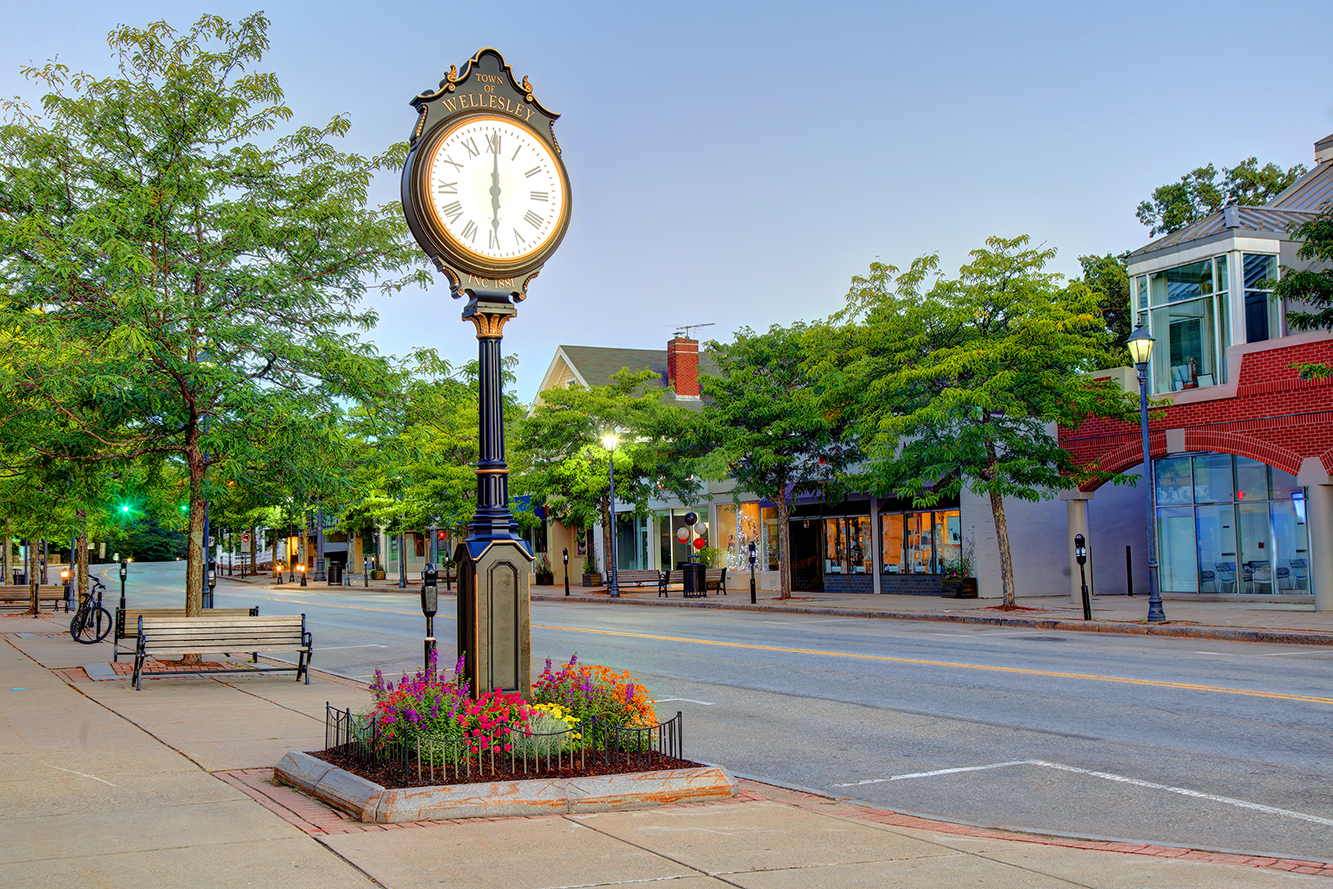
Wellesley offers several different versions of suburban living within the same town. In and around Wellesley Square, residents have convenient access to Central Street shops, restaurants, professional services, and the commuter rail station. Wellesley Hills and Wellesley Farms offer a more traditional residential experience, with established streets, mature landscaping, traditional architecture, and access to local amenities and rail service.
Other parts of town appeal to buyers looking for more space and privacy. Dana Hall offers proximity to the town center and Brook Path, while Cliff Estates, Peirce Estates, and the Country Club area are associated with larger homes and lots. Because Wellesley does not have formally designated neighborhood boundaries, local names are often used as a way to describe general areas rather than precise municipal districts. The actual property location, surrounding streets, school assignment, transportation options, and recent sales are therefore more important than a neighborhood name alone.
A Suburban Setting With Boston Access
Wellesley maintains a distinctly residential character without feeling disconnected from Greater Boston. Three commuter rail stations provide direct rail service toward Boston, while Route 9 and nearby major highways give residents additional options for commuting by car. Local institutions such as Wellesley College and Babson College also contribute to the town's employment, educational, and cultural activity.
What Kind of Homes Will You Find in Wellesley?
Wellesley's housing stock includes considerably more variety than its luxury reputation might suggest. Buyers may encounter traditional Colonials, Tudor Revival homes, Cape style properties, contemporary residences, condominiums, smaller single-family houses, renovated historic properties, custom builds, and larger estate-style homes. Some properties date back to the early twentieth century, while others have been extensively renovated, rebuilt, or replaced.
The price range can be equally broad. The lower end of the single-family market can sometimes begin below $1 million, while highly sought-after properties in areas such as Cliff Estates, Peirce Estates, and the Country Club area can reach well above $3.5 million. Recent listing data illustrates the differences between parts of town, with Realtor.com reporting a median listing price of approximately $3.97 million in Cliff Estates in May 2026, compared with approximately $2.25 million in Wellesley Hills and approximately $1.90 million in Wellesley Farms. Because neighborhood statistics can change substantially depending on the properties available at a given time, buyers should use recent comparable sales to put those figures into context.
Paul's Buyer Tip
In Wellesley, the asking price is only part of the story. Pay close attention to lot size, property condition, renovation quality, architectural character, school assignment, transit access, drainage, mechanical systems, and the surrounding homes when comparing properties. Two houses with similar prices or square footage can offer very different long-term value and ownership experiences.
Wellesley Neighborhoods to Consider
There is no single best neighborhood in Wellesley. The right area depends on what matters most to you – walkability, commuter rail access, lot size, architecture, proximity to schools, privacy, or the type of home you want to own.
Wellesley Square
Wellesley Square offers one of the town's most convenient and walkable residential settings. Central Street provides access to restaurants, shops, professional services, and everyday amenities, while the Wellesley Square commuter rail station makes the area particularly attractive to Boston commuters. Homes in and around the area range from smaller properties and traditional houses to larger residences on surrounding streets.
Wellesley Hills
Wellesley Hills combines established residential streets with convenient transportation and access to local businesses and recreation. Traditional Colonials, Tudor-style homes, and other established properties are common, and the Wellesley Hills commuter rail station provides another option for residents traveling toward Boston.
Recent listing data has placed the area's median listing price around $2.25 million, although individual properties vary considerably based on size, condition, lot characteristics, and exact location.
Wellesley Farms
Wellesley Farms is known for mature residential streets, traditional architecture, and proximity to the Wellesley Farms commuter rail station. Recent neighborhood data showed a median listing price around $1.9 million, although larger renovated homes and luxury properties can sell for considerably more.
The neighborhood can appeal to buyers who want a quieter residential environment while maintaining convenient access to rail transportation and the rest of Greater Boston.
Dana Hall
The Dana Hall area offers a combination of residential character and proximity to central Wellesley. Buyers can find homes within convenient reach of the Brook Path, schools, town center, and local amenities. Properties can vary in size and style, but the location is particularly appealing to those who want more opportunities to walk to parts of town.
Cliff Estates
Cliff Estates represents one of Wellesley's higher-end residential areas, with larger homes, spacious lots, mature landscaping, and higher price points. Recent listing data placed the median listing price near $4 million, although individual properties can fall well above or below that figure.
For luxury buyers, the appeal often extends beyond the house itself. Lot characteristics, privacy, architectural design, renovations, and the surrounding residential setting can all play an important role in the property's value.
Peirce Estates and the Country Club Area
Peirce Estates and the Country Club area are also associated with larger homes, more substantial lots, architectural character, and higher price points. Buyers looking in these areas are often focused on privacy, outdoor space, property scale, and the character of established residential streets.
How to Choose the Right Wellesley Neighborhood
Rather than asking which Wellesley neighborhood is the best, start by considering how you want your everyday life to look. Do you want to walk to Central Street? Is commuter rail access important? Would you rather have a larger lot than be close to shops? Are you looking for an older home with architectural character or a recently renovated property? Does school assignment influence your search? How important are privacy, outdoor space, and proximity to Boston? Those questions can quickly narrow the search. Wellesley does not have formal neighborhood boundaries, and property values can change considerably from one street to another. Looking at the specific location, surrounding properties, recent comparable sales, lot characteristics, and transportation options can provide a much more useful picture than relying on a neighborhood label alone.
Transit and Commuting
Transportation is one of Wellesley's strongest practical advantages for people who work in Boston or other parts of Greater Boston. The town has three MBTA commuter rail stations on the Framingham/Worcester Line – Wellesley Square, Wellesley Hills, and Wellesley Farms – giving residents several options depending on where they live.
Wellesley Commuter Rail
The three commuter rail stations are distributed across town and provide access toward Boston and communities along the Framingham/Worcester Line. For buyers who expect to commute regularly, proximity to one of the stations can be an important factor when comparing otherwise similar properties.
Route 9 and Major Highways
Route 9 provides a major east-west connection through Wellesley and links the town with surrounding communities and employment centers. I-90 and the broader Route 128 and I-95 network are accessible through neighboring communities, providing additional options for drivers traveling around the Boston area.
Employment and Local Access
Wellesley is more than a residential suburb. Wellesley College, Babson College, Dana Hall School, Sun Life Financial, Mass Bay Community College, medical organizations, office centers, retail areas, and other local employers contribute to the town's economy. Boston Logan International Airport is also accessible by road, which can be useful for residents who travel regularly.
Schools and Education
Schools are a major consideration for many households moving to Wellesley. Wellesley Public Schools includes six elementary schools; Bates, Fiske, Hardy, Hunnewell, Schofield, and Sprague – along with Wellesley Middle School and Wellesley High School. For the 2025 to 2026 school year, the district reported 3,832 students across elementary, middle, and high school grades, excluding preschool. Why Property Address Matters School assignment is connected to the property address, so buyers should verify the current assignment for any home they are considering. An older listing description or third-party website may not reflect the current situation. Wellesley also has private education options, including Dana Hall School, a private day and boarding school for girls in grades 5 through 12, as well as other private schools in Wellesley and nearby communities.
Wellesley Real Estate Market Snapshot
Market Snapshot
| Median Sale Price | ~$2.2M |
| Average Sale Price | ~$2.45M |
| Average Sale $/SqFt | $660 |
| Avg. Days on Market | ~40 days |
| Avg. Days to Offer | ~25 days |
| Typical Price Range | $675K to $3.5M+ |
| List-to-Sale Ratio | 98.8% |
| Single-Family Sales (Trailing 12 Mo.) | 294 |
| Market Condition | Very Competitive |
Market data is updated periodically and reflects recent trends. Contact Paul for the most current pricing and activity in the neighborhood you're considering.
What This Means for Buyers
Buyers should avoid assuming that every Wellesley property requires the same strategy. A home near commuter rail may carry different value considerations than a property where lot size and privacy are the primary attractions. Buyers should compare homes against relevant recent sales while also considering condition, renovations, location, school assignment, transportation, and potential future ownership costs.
What This Means for Sellers
Sellers should also avoid relying exclusively on a townwide median when determining a listing price. The strongest pricing strategy considers the property's specific neighborhood, lot, condition, architecture, improvements, competition, and likely buyer pool. Professional presentation, accurate pricing, strong photography, and thoughtful positioning can become particularly important when marketing higher-priced Wellesley properties.
Parks, Open Space and Recreation
One of Wellesley's advantages is the amount of green space available within an established suburban community so close to Boston. Morses Pond provides seasonal opportunities for swimming, kayaking, fishing, and other recreation, while areas such as Boulder Brook Reservation, Centennial Reservation, Fuller Brook Path, and Town Forest provide additional opportunities to walk, explore, and enjoy nature.
Fuller Brook Path and Local Open Space
Fuller Brook Path is one of the better-known outdoor destinations in town, connecting residential areas with green space and providing opportunities for walking and enjoying the landscape. Wellesley's broader open space system also includes areas used for hiking, cross-country skiing, fishing, swimming, kayaking, and nature observation.
Lake Waban
Lake Waban, associated with Wellesley College, provides another familiar local setting for walking and enjoying the natural landscape around the college campus. Together, these outdoor spaces help give Wellesley a quieter suburban feel despite its proximity to Boston.
Shopping, Dining and Local Life
Wellesley provides a stronger local retail and dining environment than many suburban communities where residents rely heavily on nearby commercial centers. Wellesley Square and Central Street are central to the town's everyday activity, offering restaurants, shops, professional services, and other conveniences.
Wellesley Square
Wellesley Square is the town's most recognizable commercial center, combining local businesses with restaurants, services, and access to commuter rail. Its walkability is one of the reasons properties within convenient reach of the area can be particularly attractive to buyers who want more convenience in their daily routine.
Linden Square and Wellesley Hills
Linden Square provides another important shopping and dining destination, while Wellesley Hills and the Route 9 corridor add additional retail, restaurants, services, and everyday conveniences. The combination gives residents multiple options without requiring every shopping or dining trip to Boston.
Colleges and Community Character
Wellesley College and Babson College also contribute to the town's identity. Their campuses, students, faculty, and educational institutions add an academic presence to the community and connect Wellesley to the broader Boston area's educational and professional landscape.
Why Buyers Choose Wellesley
Schools That Drive Decisions
Education is the single most common reason families move to Wellesley. The public school district carries an A+ rating from Niche, and Wellesley High School ranks in the top 10 public high schools in Massachusetts. The town’s six elementary schools each serve specific neighborhoods, which means your home address determines your child’s school assignment. Hardy, Hunnewell, Fiske, Bates, Sprague, and Schofield each have strong reputations, and school assignment is often a factor in which neighborhood a family targets. On the private side, Dana Hall School is located in town, and schools like Noble and Greenough in Dedham and Rivers School in Weston are a short drive away.Three Ways Into Boston
Wellesley’s transit access is unusually strong for a suburb at this price point. Three commuter rail stations on the Framingham/Worcester Line (Wellesley Square, Wellesley Hills, and Wellesley Farms) put Back Bay and South Station roughly 25 minutes away during peak hours. The Green Line D branch is accessible at the Woodland and Waban stations near the Newton border. And for drivers, Route 9 provides a direct east-west corridor while I-90 (Mass Pike) is accessible through neighboring Weston. Most residents who commute to downtown Boston report a door-to-door time of 30 to 45 minutes depending on mode and destination.A Town Center That Still Feels Like a Town
Wellesley Square along Central Street has managed to hold onto its independent character. Rather than chain restaurants and big-box retail, you’ll find locally owned shops, restaurants, and services. Linden Street offers a second cluster of dining and convenience. The Route 9 corridor through Wellesley Hills adds additional retail, grocery, and medical services. Residents regularly mention the walkability of Wellesley Square as a standout quality, particularly buyers coming from more car-dependent suburbs further west.Outdoor Space and Recreation
Wellesley offers more green space than most buyers expect. Morses Pond is the town’s primary summer recreation spot with a public beach. Lake Waban on the Wellesley College campus is a popular walking destination. The Brook Path connects several neighborhoods to the town center on foot. Boulder Brook Reservation, the Centennial Reservation, and the Charles River frontage along Ridge Hill provide additional trails and open space. The town also maintains extensive playing fields at Sprague and Hunnewell for youth sports.Homes for Sale in Wellesley MA
This content is currently unavailable. Please check back later or contact the site's support team for more information.
Don’t see what you’re looking for? Many homes in Wellesley sell before they ever hit the public market. Contact Paul to learn about upcoming and off-market opportunities.
Thinking About Wellesley? Let’s Talk.
Whether you’re relocating to the Boston area, moving up from a neighboring town, or considering selling your Wellesley home, Paul Neavyn brings over 20 years of real estate and construction experience to every transaction. With 60+ five-star reviews and a deep understanding of Wellesley’s neighborhoods, Paul helps buyers and sellers make informed decisions backed by real market knowledge.

Paul Neavyn | Global Real Estate Advisor
Gibson Sotheby’s International Realty
