


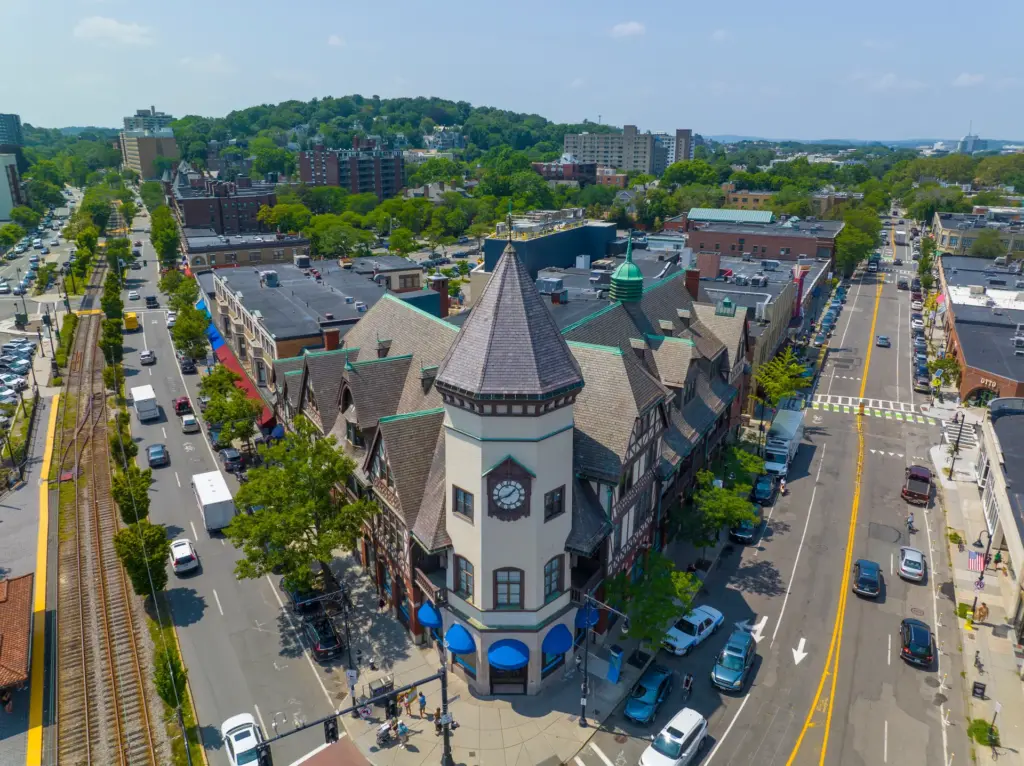
Brookline, MA is one of the most distinctive residential markets in Greater Boston. It borders Boston on three sides, and all three Green Line branches serve it. It also holds some of New England’s most architecturally significant residential streets. So it sits in a category of its own among MetroWest communities. Walkable village centers anchor Coolidge Corner and Brookline Village. Estate-scale neighborhoods define Chestnut Hill and Fisher Hill. The property tax structure also favors owner-occupants in ways most buyers miss. That variety is why comparing Brookline MA neighborhoods rewards a closer look.
This guide goes deeper than the typical neighborhood overview. It comes from a Global Real Estate Advisor with Gibson Sotheby’s International Realty. He also brings 20+ years of high-end residential remodeling and an active general contractor’s license.
His hands-on project history inside Brookline runs deep. It spans both the historic mansion units and new construction at Longyear at Fisher Hill, up to the most exclusive penthouse. It also includes the active listing at 142 Crafts Road in Chestnut Hill. Mansion Global named that home its Listing of the Day on April 22, 2026.
For broader Brookline context on schools, transit, taxes, and current listings, visit my Brookline community page. What follows is a full breakdown of Brookline neighborhoods, one at a time.
The 2026 Brookline Market
A complete picture of Brookline’s market, then, requires looking at the segments separately. Between January 1, 2025 and May 28, 2026, 716 residential properties have closed in Brookline. So the character of those transactions tells you most of what you need to know about the town.
Volume: Brookline is a condo market
By volume, Brookline is overwhelmingly a condo market. Of the 716 closings in the 16 months ending May 28, 2026, 548 were condominiums and 168 were single-family homes. In fact, condos represent 77% of transaction volume. The single-family segment is the smaller, higher-priced piece of the market. So it behaves differently from the condo segment in pricing, time-on-market, and negotiating dynamics.
Pricing by segment
- Single-family: 168 closings, averaging 4,061 sq ft and $795 per square foot. Average sale price $3,145,204, 63 days on market, 96.6% sale-to-list ratio.
- Condo: 548 closings, averaging 1,500 sq ft and $836 per square foot. Average sale price $1,255,447, 47 days on market, 99.8% sale-to-list ratio.
The counterintuitive finding
Price per square foot tells a story you would not expect. Condos in Brookline trade at $836 per square foot, single-family homes at $795. Still, this is not typical of suburban markets, where larger single-family inventory usually commands the per-square-foot premium. The explanation is location. Brookline’s premium condo inventory sits in Coolidge Corner, Washington Square, Longwood, and the urban core. Those, in particular, are walkable, transit-adjacent locations that command higher per-square-foot pricing. The single-family inventory includes more outlying stock across South Brookline and the edges of town. So that moderates the segment average.
Negotiating leverage by segment
Single-family buyers in Brookline have meaningful negotiating room. The 96.6% sale-to-list ratio across 168 closings tells the story. The typical single-family sale closes at a 3 to 4 percent discount from list. Condo buyers face a much tighter market. At 99.8% sale-to-list, the typical condo sale closes within a fraction of a percent of list. So you face two different negotiating climates, depending on which product type you are shopping.
April 2026 momentum signal
For a narrower look at recent direction, consider April 2026. That month, Brookline shifted into seller-favorable territory for the first time since June 2025. Months of supply, in particular, compressed from 4.4 to 3.6. The median sale-to-list ratio returned to 1.00, and 46.8% of sales closed above asking. In short, the April snapshot reinforces the structural picture above. Brookline buyers are competing for limited inventory, and the tightest competition sits in the condo segment.
Cross-MetroWest context
Brookline operates as a different market from neighboring Wellesley. In contrast, Wellesley’s 16-month data over the same window shows 339 closings. They averaged $2,468,000 at $660 per square foot with 41 days on market. That is a higher-priced, lower-volume, single-family-dominant suburban market. Brookline tells a different story. Its 716 closings split 77% condo and 23% single-family, a higher-volume, condo-dominant urban-suburban hybrid with structurally different pricing by segment. So buyers comparing across MetroWest in 2026 are operating in fundamentally different markets, depending on which town they shop. For more on the Wellesley side, see my Wellesley neighborhoods guide.
How Brookline Neighborhoods Work
Brookline has approximately 64,000 residents across 6.8 square miles. That also makes it one of the most densely populated towns in Massachusetts. Eight recognized Brookline neighborhoods organize the town. They are Coolidge Corner, Brookline Village, Washington Square, Chestnut Hill (Brookline portion), Fisher Hill, Longwood, North Brookline, and South Brookline. Each also has its own commercial center, transit connection, and architectural character.
Three things should anchor your Brookline neighborhood search:
- Green Line access: All three Green Line branches serve Brookline. The B branch runs along Commonwealth Avenue and serves North Brookline. The C branch runs along Beacon Street through Coolidge Corner and Washington Square. The D branch (Riverside Line) runs through Brookline Village, Brookline Hills, and Reservoir. Its Chestnut Hill station serves the Chestnut Hill neighborhood. Most Brookline residents are within a 5 to 15 minute walk of a stop.
- Condo versus single-family: Brookline’s housing stock is heavily condo-weighted in the urban core, meaning Coolidge Corner, Washington Square, North Brookline, and Longwood. It is heavily single-family-weighted in the estate neighborhoods, meaning Chestnut Hill, Fisher Hill, and South Brookline. So per-square-foot pricing varies meaningfully between segments, with condos commanding a location-driven premium.
- Historic districts: Brookline has multiple historic district overlays. They include Chestnut Hill North Local Historic District, Pill Hill, Cottage Farm, and Fisher Hill. These districts constrain new construction and exterior alterations, which preserves character but adds layers to renovation projects. See the Town of Brookline Historic Districts page for current district maps.
Construction era across Brookline
Brookline’s housing stock spans the mid-1800s to today. Late-Victorian and early-1900s architecture concentrates in Brookline Village, Fisher Hill, and parts of Coolidge Corner. The 1920s through 1930s produced much of Chestnut Hill’s estate inventory. South Brookline has more mid-century and later construction. So construction era varies sharply across the town. Foundation type, framing method, electrical system, and long-term ownership cost all vary with it.
Coolidge Corner
Transit: Green Line C branch (Beacon Street) | Character: Walkable urban hub
Coolidge Corner is Brookline’s most urban and walkable neighborhood. In fact, the intersection of Beacon and Harvard ranks among the most active commercial centers in Greater Boston outside Boston itself. There you also find the Coolidge Corner Theatre, Trader Joe’s, restaurants, cafes, and boutique retail clustered within a few blocks. The C branch of the Green Line runs directly along Beacon Street, with multiple stops in the neighborhood.
Housing is predominantly condos and apartments in mid-rise and high-rise buildings, with brownstones and triple-deckers on the side streets. Single-family homes exist, but they are the minority. Generally, condo prices range from the mid-$500,000s for one-bedrooms to $2 million and above for premium units. Single-family homes here, in contrast, range widely from approximately $1.5M to over $4M.
Local Insight
Coolidge Corner is the closest you can get in MetroWest to genuine urban living without crossing into Boston. The trade-off is density and noise. The benefit is a walkable lifestyle, transit access, and a community character that doesn’t require a car. So the condo buildings here range significantly in construction era and quality. Pre-war buildings have character, but they often need significant systems work. Newer post-2000 buildings deliver predictability, yet they cost more per square foot.
Best for: Buyers who want walkable urban living, Green Line access, and a vibrant restaurant and retail scene.
Brookline Village
Transit: Green Line D branch (Brookline Village station) | Character: Historic origin point
Brookline Village is the historical heart of the town. The original village center still runs along Washington Street near the Boston border. It also holds the town’s oldest commercial buildings and some of its most distinctive 19th-century architecture. The D branch Riverside Line stops at Brookline Village station. From there, direct service reaches Park Street and Government Center in roughly 20 to 25 minutes.
Housing includes Victorian and early-1900s single-family homes, condos in converted multi-families, and newer condo construction. Generally, single-family homes range from $1.5M to $3.5M, with the larger Victorian properties on streets like Walnut Street reaching higher. Condos, meanwhile, start in the high $400,000s in older buildings and reach $1.5M+ in newer construction.
What I Notice as a Contractor
The Victorian housing stock in Brookline Village includes some of the finest residential carpentry in Greater Boston. Hand-cut joinery, old-growth lumber, plaster walls with picture rail molding, custom millwork on every floor. So maintaining these homes well requires understanding how they were built. I have seen well-intentioned renovations seal these homes up with modern vapor barriers and spray foam. That traps moisture, the exact problem the original wood-frame construction was designed to avoid. Updating without destroying the original building science takes real expertise. I bring that from years of hands-on work in homes exactly like these. For a deeper look, see what a licensed general contractor sees that most buyers miss.
Best for: Buyers who want historic character, transit access, and proximity to both Coolidge Corner and Boston’s Longwood Medical Area.
Washington Square
Transit: Green Line C branch (Washington Square station) | Character: Quieter village feel between Coolidge Corner and Cleveland Circle
Washington Square sits along Beacon Street between Coolidge Corner and the Cleveland Circle area. It has a more residential, quieter character than Coolidge Corner. Still, it offers walkable amenities, including restaurants, shops, and the popular Washington Square commercial strip. The Green Line C branch also serves the neighborhood directly.
Housing is a mix of condos in mid-rise buildings, two- and three-family homes, and single-family inventory on the side streets. Generally, condo prices range from the high $500,000s to $1.5M. Single-family homes, meanwhile, range from approximately $1.8M to $4M.
Best for: Buyers who want Green Line access and walkable amenities with a quieter character than Coolidge Corner.
Chestnut Hill (Brookline portion)
Transit: Green Line B and D branches; Chestnut Hill station on the D branch | Character: Estate properties, prestige luxury
Chestnut Hill straddles Brookline, Newton, and Boston. The Brookline portion sits west of Hammond Street. Indeed, it holds some of the most architecturally significant residential properties in Greater Boston. The neighborhood is anchored by Boston College’s law school campus and The Street at Chestnut Hill shopping development. Both the B branch (toward BC) and D branch (Chestnut Hill station) also serve the area.
Housing is predominantly large single-family homes on substantial lots, with grand colonials, Tudors, Spanish Colonials, and French-inspired estates. Generally, prices range from $3M to over $15M, with the 2025 luxury segment seeing a $17M transaction. Newer construction at the upper end of the market, meanwhile, regularly pushes $5M to $10M.
What I Notice as a Contractor
The original homes in Brookline’s Chestnut Hill represent some of the finest residential construction in Greater Boston. Stone foundations. Custom millwork. Slate and copper roofing. Plaster walls with picture rail molding. That kind of craftsmanship, after all, reflects an era when materials and labor were not value-engineered. My active listing at 142 Crafts Road is a 1905 Chapman & Frazer Spanish Colonial that captures this exact tradition. It was named Mansion Global’s Listing of the Day on April 22, 2026.
I have also done renovation work on a Chestnut Hill mansion owned by a Boston Celtics ownership group member. That work sits among many other estate homes I have renovated nearby. At $3M and up, a few questions matter most. How were systems integrated through the historic structure? What is the long-term plan for slate, copper, and masonry? And on new construction, does the build quality match the price tag?
Best for: Buyers with a larger budget who want prestige, space, and some of the finest residential architecture in Greater Boston.
Fisher Hill
Transit: Near Reservoir station on the Green Line D branch | Character: Olmsted-designed historic estates
Fisher Hill is one of the most architecturally and historically significant residential neighborhoods in Greater Boston. The hill itself is an Olmsted-designed area. Curving streets, mature landscapes, and grand estates from the late 19th and early 20th centuries define it. The Fisher Hill Historic District overlay also preserves the architectural character. Reservoir station, meanwhile, sits at the edge of the neighborhood on the D branch.
Housing is predominantly large single-family homes on generous lots, with concentrations of Tudor, Colonial Revival, and Shingle Style architecture. The hill also includes Longyear at Fisher Hill, a 43-residence luxury condominium community. Its five buildings sit on an eight-acre estate. The historic Longyear Mansion, completed in 1906, was converted to condominiums in 2003. Four purpose-built new construction buildings were added to the estate between 1999 and 2007. Generally, pricing for Fisher Hill single-family homes runs from $2.5M to over $10M. Longyear residences, meanwhile, have transacted from approximately $2.7M to $8.1M.
What I Notice as a Contractor
I have worked across both the historic mansion units and the new construction buildings at Longyear at Fisher Hill. That work included the most exclusive penthouse. The construction quality across both eras, indeed, matches the premium positioning. For buyers in Fisher Hill more broadly, the housing stock spans a wide range. It runs from estate homes built between 1890 and 1930 to occasional newer construction. The original homes were built when residential construction was closer to fine art than to building science. So maintaining them well requires real expertise. For a deep look at Longyear specifically, see my Longyear at Fisher Hill guide.
Best for: Buyers who want historic significance, Olmsted-designed setting, and proximity to Coolidge Corner without being in it.
Longwood
Transit: Green Line D and C branches; near Longwood Medical Area | Character: Medical professional hub
Longwood sits along the Brookline-Boston border, next to the Longwood Medical Area. That cluster includes Beth Israel Deaconess, Brigham and Women’s, Children’s Hospital, Dana-Farber, and Harvard Medical School. So the neighborhood appeals strongly to medical professionals who value proximity to work, transit access, and Brookline’s schools.
Housing is predominantly condos and apartments in mid-rise and high-rise buildings. In particular, the Longwood Towers complex is one of the most distinctive prewar high-rise condo buildings in Greater Boston. Generally, condo prices range from the high $400,000s for one-bedrooms to $2M+ for premium units. Single-family homes are limited, but they exist on the residential side streets.
Best for: Medical professionals, buyers prioritizing transit and walkability to the medical area, and condo buyers seeking a more established urban character.
North Brookline
Transit: Green Line B branch (Commonwealth Avenue) | Character: Boston-adjacent, denser, more affordable entry
North Brookline runs along the Boston border, bounded roughly by Commonwealth Avenue and Beacon Street. By and large, the neighborhood has the densest housing stock in Brookline. It also offers some of the most accessible entry points to the town. The B branch runs along Commonwealth Avenue, with multiple stops in and near the neighborhood. So it gives direct service to BU, downtown Boston, and beyond.
Housing is predominantly condos, apartments, and brownstones in mid-rise buildings. Single-family homes are rare. Generally, condo prices range from the high $400,000s to $1.2M.
Best for: Buyers prioritizing accessible Brookline entry pricing, BU-area proximity, and Green Line B branch access.
South Brookline
Transit: Bus routes; nearest D branch stations are at Reservoir and Chestnut Hill | Character: Lower density, more suburban feel
South Brookline covers the more residential southern portion of the town. It also includes Putterham, Hancock Village, and the area near the Brookline-Newton border. Density is lower than the urban core, and the character is closer to a traditional residential suburb. The Larz Anderson Auto Museum and Larz Anderson Park anchor the neighborhood as community amenities. Boundary streets connect to Newton’s Chestnut Hill and Newton Centre.
Housing is predominantly single-family homes, with some condo and townhouse developments. Generally, single-family prices run from approximately $1.2M to $3.5M, the most accessible single-family entry points in Brookline.
Best for: Buyers who want Brookline schools and town services with a more suburban character and the most accessible single-family pricing in the town.
Brookline Property Tax: FY26 Math
Brookline’s property tax structure is one of the most underserved buyer topics in Greater Boston content. It also differs significantly from neighboring Newton and Wellesley. Understanding it correctly, then, can change the buyer math by hundreds of dollars per month.
The base rate and split structure
Brookline operates under a split tax rate. For FY26, the residential rate is $10.24 per $1,000 of assessed value. Meanwhile, the commercial rate is $17.16 per $1,000. The residential factor is 0.925449 and the commercial factor is 1.75. Those reflect the town’s policy of shifting part of the levy from residential to commercial property owners. The Select Board, meanwhile, votes annually on the classification.
The 20% residential exemption
This is where Brookline differs most from Wellesley and Newton. Brookline offers a 20% residential exemption for owner-occupants who file an application. The FY26 exemption value is $354,974 of assessed value, equivalent to approximately $3,634.93 in annual tax savings (approximately $303/month). The exemption is granted on a continuing basis once approved. So you don’t need to refile every year. Still, new buyers should plan to file the application within the deadline of their first year of ownership. See the Town of Brookline Residential Exemptions page for current applications and deadlines.
Median FY26 tax bills
Based on the town’s November 2025 tax classification reporting:
- Median single-family bill: approximately $20,904 per year (median assessed value $2.04M, up 6.1% from FY25). For owner-occupants with the residential exemption applied, effective bill is approximately $17,269.
- Median condo bill: approximately $4,704 per year (median assessed value $484,626, up 5.5%). For owner-occupants with the residential exemption applied, effective bill is approximately $1,069.
- Median multifamily bill: rose approximately 6.5% in FY26.
The residential exemption substantially compresses the effective tax cost for owner-occupants of moderately-priced Brookline condos in particular. A median condo owner-occupant pays approximately $1,069 per year. A non-owner-occupant on the same property pays approximately $4,704. So that gap shapes buyer math, investment decisions, and rent-versus-own tradeoffs. Buyers comparing Brookline to other Greater Boston markets often miss it.
Schools
Brookline Public Schools is consistently ranked among the top public school districts in Massachusetts. The system includes eight K-8 elementary schools, plus Brookline High School. Those elementaries are Baker, Driscoll, Heath, Lawrence, Lincoln, Pierce, Runkle, and The Florida Ruffin Ridley School. The K-8 structure means students stay at their elementary building through 8th grade. So they skip the move to a separate middle school, which is unusual among top Massachusetts districts. Generally, the home address determines elementary school assignment. For current boundaries and information, see Brookline Public Schools. Still, always verify the specific address with the district before making decisions.
How to Choose Among Brookline Neighborhoods
Finding the best Brookline neighborhood for your situation depends on what you value most. A framework to narrow your search:
Want the most urban, walkable lifestyle? Coolidge Corner.
Looking for historic character with transit? Brookline Village or Washington Square.
Need the most prestigious estate properties? Chestnut Hill (Brookline portion) or Fisher Hill.
Working in the medical area? Longwood.
Want accessible Brookline entry pricing? North Brookline (condos) or South Brookline (single-family).
Need a more suburban feel within Brookline? South Brookline.
Olmsted-designed setting and historic significance? Fisher Hill.
And the most important advice: visit in person. Walk the streets at different times of day. Try the trolley. Get a coffee in the neighborhood. After all, every part of Brookline looks good on paper. The real question is which one fits your daily life.
For a complete cross-MetroWest comparison, see my Newton MA villages guide and Wellesley MA neighborhoods guide. The three towns serve different buyer profiles and operate as structurally different markets in 2026.
Finding Your Brookline Neighborhood
Brookline is a town where every neighborhood delivers top-tier schools, strong property values, and urban-suburban hybrid living. A community character shaped by more than three centuries of history runs through all of it. So the differences come down to lifestyle, transit, budget, and the specific property you choose.
What I bring to that search is depth on the market and the housing stock. That depth also goes beyond what most agents offer. It comes from 20+ years of high-end residential construction, including hands-on project history inside some of Brookline’s most significant properties. So I help you understand both the neighborhood and the home itself.
I would be glad to help you find the part of Brookline that feels right for you.
Browse Brookline MA homes for sale | Let’s connect
About Paul Neavyn
Paul Neavyn is a Global Real Estate Advisor with Gibson Sotheby’s International Realty. He is based at 54 Central Street in Wellesley, MA. He is also recognized in the RealTrends Top 1.5% of agents nationwide. That track record includes 90+ successful transactions, 50+ five-star Google reviews, and 25+ five-star Zillow reviews.
Paul also brings a rare second credential to his real estate practice. For 20+ years he ran a high-end residential remodeling company. It specialized in the renovation and restoration of historic homes across MetroWest Boston. He also holds an active general contractor’s license. Born and raised in Newton, he is a graduate of Newton North High School. Today he specializes in Brookline, Wellesley, Newton, Weston, Southborough, Hopkinton, and the surrounding MetroWest Boston communities.
His Brookline project history runs deep. It spans the historic mansion units and the new construction buildings at Longyear at Fisher Hill. Indeed, that work reached the most exclusive penthouse. It also covers a Chestnut Hill mansion owned by a member of a Boston Celtics ownership group. His current active listing at 142 Crafts Road in Chestnut Hill rounds it out. Mansion Global named that home its Listing of the Day on April 22, 2026.